
Habermas vs. Ratzinger: A Model for Thoughtful Dialogue
Recently, someone suggested that I debate an atheist friend of ours about religion. If ever a serious invitation comes up, I would be inclined to accept it, as I find serious conversations about faith and reason interesting.
But to be honest, whenever suggestions such as this come up, I experience a certain hesitation: not because I fear disagreement, but because many contemporary debates about religion are little more than echoes of familiar talking points inherited from the polemics of the “New Atheists.”
Figures like Christopher Hitchens or Richard Dawkins built their public reputations on confident denunciations of religion as irrational, dangerous, or obsolete. Dawkins even calls religious beliefs a “mind virus.” Their rhetorical skill made them formidable debaters, for sure, but their arguments often lacked philosophical depth. If you want proof of this, just listen to their debates with the philosopher Dr. William Lane Craig or the mathematician Prof. John Lennox.
In the New Atheists, one encounters more theatrical performances than genuine inquiry. And for me, while such debates generate heat, they emit very little light.
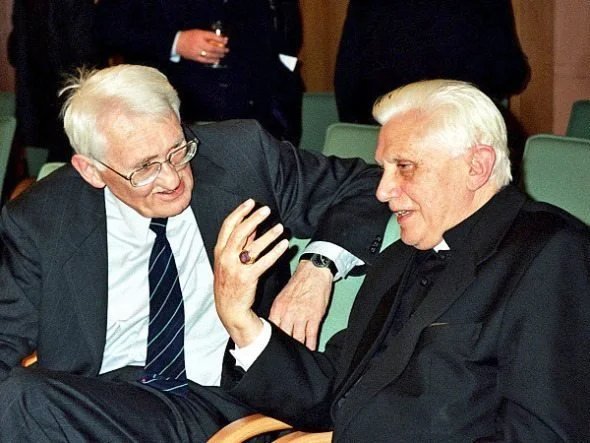
If one wishes to see what a genuinely fruitful encounter between a theist and an atheist looks like, one must turn instead to a remarkable exchange that took place in 2004 at the Catholic Academy of Bavaria between the German philosopher Jürgen Habermas and Joseph Cardinal Ratzinger. Their debate is not on the existence of God, but on pre-political moral foundations of a free state, and on the role and value of religion in a democratic society.
Even twenty-two years later, with both men now deceased, that dialogue remains one of the most intellectually honest conversations between secular and Christian thinkers in recent decades. While I haven’t seen any video or audio recording of the exchange, one can read their exchange in a book called: The Dialectics of Secularization: On Reason and Religion.
Habermas: An Honest Enlightenment Thinker
Habermas spent his career as one of the most influential defenders of secular liberal democracy. Evidence of this is the fact that he debated Joseph Cardinal Ratzinger in January 2004, just over a year before the latter was elevated to Supreme Pontiff of the Catholic Church.
In many ways, he represents the mature voice of the Enlightenment. His philosophical project aimed to ground political legitimacy in rational discourse rather than religious authority. Yet what makes Habermas remarkable is not simply his defense of secular reason but his willingness to acknowledge its limits.
One of the central questions he confronted comes from the German constitutional scholar Ernst-Wolfgang Böckenförde. The problem, which is often called the Böckenförde dilemma, asks: Does the free, secularized state exist on the basis of normative presuppositions that it itself cannot guarantee?
The question assumes, and rightly so, that a liberal democracy requires citizens who possess virtues such as solidarity, civic responsibility, and a willingness to sacrifice private interest for the common good. Yet the state, precisely because it respects freedom, cannot simply legislate these virtues into existence.
Habermas recognized the vulnerability implicit in this arrangement. A society governed only by law, without deeper moral bonds, risks fragmentation. That is, citizens may become what he once described as “isolated monads,” individuals who treat their rights primarily as weapons against one another rather than as instruments of shared political life.
The point is this: Law can regulate behavior, but it cannot generate solidarity.
The Emergence of a Postsecular Society
This recognition led Habermas, surprisingly, to challenge one of the Enlightenment’s most confident predictions: that religion would gradually disappear from modern societies. In a widely discussed speech delivered in 2001, he argued that Western societies had instead entered what he called a “postsecular” phase. Religion had not vanished under the pressure of modernization; it remained a powerful cultural and moral force.
More importantly, Habermas argued that secular reason itself might still have something to learn from religious traditions. For much of the twentieth century, intellectual culture treated religion as a relic, that is, an artifact destined to fade as scientific rationality advanced. Habermas rejected this assumption. Religious traditions, he argued, preserve moral intuitions and conceptual resources that modern philosophy cannot easily replace.
Interestingly, the New Atheist Richard Dawkins has lately become more sympathetic to this sentiment as he witnessed how the erosion of the influence of Christianity has shaken his country to its core. Today, he calls himself “a cultural Christian.”
For Habermas, sacred texts contain centuries of reflection on suffering, guilt, redemption, and the failures of human life. These moral languages often express experiences and social pathologies that purely technical or bureaucratic reasoning struggles to articulate. In other words, religion carries a form of moral knowledge that a purely secular discourse risks losing.
Translating Religious Insight
Did Habermas have a sudden change of heart? No. Habermas did not ask Ratzinger to baptize him and hear his confession after their debate (though I hope he did). Moreover, Habermas did not propose that modern societies return to theological politics. Instead, he suggested a process he called “translation.”
In pluralistic societies, religious ideas must sometimes be translated into a language accessible to believers and nonbelievers alike. This allows the moral substance of religious traditions to continue shaping public life without requiring universal agreement about theology.
His most famous example concerns the biblical idea that human beings are created in the image of God. Within Christian theology, this concept grounds the incomparable value of every human person.
In secular political language, the same moral intuition appears in the concept of human dignity. That is, the claim that every person possesses equal and inviolable worth. The theological language changes, but the ethical insight remains the same.
Habermas even suggested that many central principles of modern democracy emerged through precisely this historical process. Concepts such as human rights, equality before the law, and universal dignity grew out of moral intuitions first articulated within Christian thought and later translated into secular political language.
Thus the Enlightenment itself did not simply replace religion. In many cases, it quietly inherited and reformulated its moral vocabulary.
Perhaps the most obvious example we can think of is the way the theological language of the US Declaration of Independence has been eroded. It did not help that they phrased it this way: “We hold these truths to be self-evident, that all men are created equal…” When they claim that it is simply self-evident to man, it takes away the necessity of realizing that the dignity of man comes from God.
A Surprising Convergence
The 2004 dialogue between Habermas and Ratzinger produced an unexpected result: a significant degree of agreement. Ratzinger acknowledged that religion can develop its own pathologies: history provides sobering examples of fanaticism and violence carried out in the name of faith. But he also insisted that reason is not immune to distortion. Technological rationality detached from moral reflection can produce its own catastrophes: nuclear weapons, totalitarian social engineering, and the reduction of human beings to objects of technical manipulation.
In short, religion without reason can become fanatical, but reason without moral depth can become blind.
Both thinkers ultimately concluded that religion and secular reason must function as mutual correctives, each restraining the excesses of the other. Reason disciplines religion against fanaticism; religion reminds reason of moral limits and ultimate questions that the technocratic mentality often forgets.
If you are a Catholic who has studied the faith, you would not be surprised at how Cardinal Ratzinger argued here. The Church has always valued reason, something made especially clear in Saint John Paul II’s encyclical Fides et Ratio (On Faith and Reason).
A Better Kind of Debate
This is the kind of conversation I would hope to have with any thoughtful atheist: not a debate conducted through slogans or internet polemics, but one that begins with a shared recognition of the fragility of modern moral life. Liberal societies depend on reservoirs of solidarity and moral commitment that cannot easily be manufactured by law, markets, or technology.
Habermas, a “methodological atheist” philosopher deeply shaped by Enlightenment rationality, recognized this fact with remarkable honesty. His willingness to engage religious thought not as an enemy but as a potential partner in moral reflection marks him as one of the most intellectually serious secular thinkers of our time. It is rare to find an atheist Enlightenment thinker who calls for “a double learning process that compels both the traditions of the Enlightenment and the religious doctrines to reflect on their own respective limits.”
If discussions between believers and unbelievers followed the model of Habermas and Ratzinger rather than the style of ideological combat that dominates contemporary discourse, we might discover something unexpected. The goal of such conversations would no longer be the defeat of one’s opponent; it would be the preservation of the moral and intellectual foundations upon which our common life depends.
As a Catholic, I pray for the soul of Jurgen Habermas who recently died at the age of ninety-six. I also pray that his family may find consolation from the Sacred Heart of Christ. Let us also pray for the soul of Pope Benedict XVI (then Joseph Ratzinger) who died in 2022. May he be raised to the altar as a saint and declared “Doctor of the Church” in the years to come.