
Mary’s Assumption into a Life with God
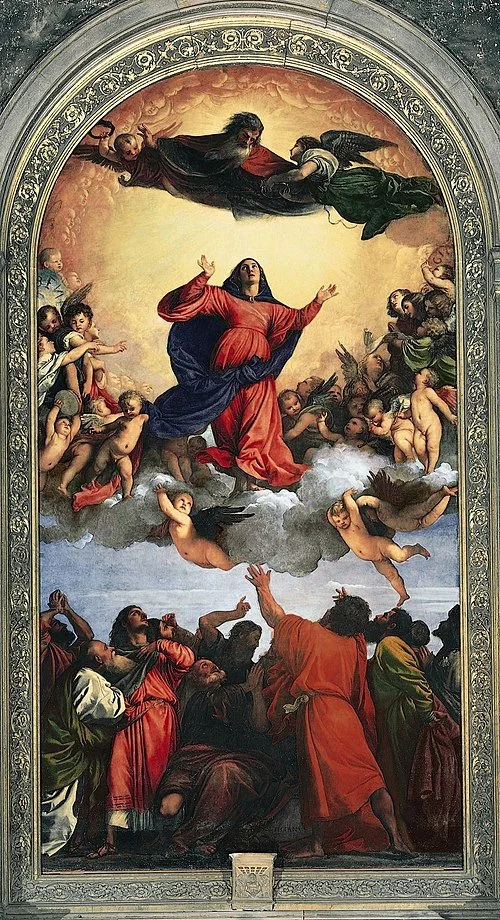
As Cordillerans—especially Kankanaeys—we usually understand the passing of a person as a gradual exit in this life, to a life with the deities in the hereafter. Elders—if I am not mistaken—call this makikabunian. Once they are with the Kabunians, they guard their family, their communities, and the land. Great reverence is shown to the ancestors, for they are now the Kabunians who are to look the well-being of their loved ones and communities.
Mary is far different from our Igorot eschatology, given her Jewish background. Nevertheless, our Igorot vision of an afterlife presents a glorified state of life with God, leading us to embrace our faith all the more: for we are not destined for death, but rather life with God. Mary, a woman of faith, waited expectantly—like other Jews—for the coming of the Messiah. She embodied the hopes and anxieties of her own people as she sung with gusto her Magnificat in the Lucan narrative. She was chosen ever since history began to be God's mother. Though she was never forced to accept God’s will, she—bearing the situation of her time in her heart—nevertheless agreed to that divine will. But with all of our musings about Mary, how do we make sense of Mary being assumed into heaven both body and soul?
First, Mary’s assumption teaches us about her humility. Humility means that we cannot depend on ourselves alone to be good. It is to acknowledge the power of God who alone can be the source of our goodness. Mary was assumed not because of her own merits, but because of God working in her. Mary depended on God, as she became instrumental in the work of salvation. It is through God that Mary was exalted. God exalted her, because she humbly offered herself to the Lord—so that in her womb the eternal Word would become man and proclaim the Kingdom of God in word and in deed, and in a manner intelligible for both man and Creation. His word would not please everyone—especially not those who indulge themselves in power and bring suffering unto others.
Second, Mary prefigures the Church, which will soon be transformed in the New Creation. Mary’s assumption is eschatological—thus giving us hope that God's love will triumph against all odds and evils. Mary is a realized eschatology, in which she is now a new Creation. Her life with God consists in her transformed “life,” in which her body and soul are glorified. We Christians, who are baptized in Christ, are a new Creation—yet we wait patiently for the fullness of salvation. This does not mean that only the spirit will share life with God. We are not disembodied beings, and so both our bodies and souls must share in the glorified state of Christ. Saint Paul vehemently proclaims this in 1 Cor 15:53: “For that which is corruptible must clothe itself with incorruptibility, and that which is mortal must clothe itself with immortality.” This is our Christian hope: that we too will be assumed or raised up into the life of God, where “there shall be no more death or mourning, wailing or pain, [for] the old order has passed away” (Rev 21:4).
While we are still on a pilgrim to our blessed life with God, let us continue to safeguard our dignity as baptized in Christ, by showing our concern for “the bodies of our brothers and sisters who are suffering due to the unjust structures present in society.” Salvation is holistic, and that includes the total liberation of humanity and Creation from everything that hinders their life with God.
Third, Mary was assumed not in order to stray away from the griefs and hurts of mankind, but rather to carry all these into her heart. Mary was a product of her historical time frame. She became the mother of Jesus, in a time where there is intense political and social turmoil in Palestine. She sung in praise to God her Magnificat that announces liberation to the victims of injustice, but judgement to those who abused the poor. Mary's assumption heralds the prophetic vision of God where love and justice prevails. In the final moment of history, we hope and believe that as we struggle against the forces of death—such as injustices done to humankind and the earth—God will bring our prophetic actions into fruition. Let us not be weary to denounce everything that costs the lives of people due to the greed of those powers that be. Let our “yes” lead us to lift up the lowly, to be the voice of those who are silenced, and to fill the stomachs of those who hunger for food, love, and mercy.
Mary, show us the way to live our lives in accordance with the will of God. May we become the servants of a New Creation waiting to be born, and transform our relationships. May we say “yes” to Christ, and may our “yes” be shown in ways that confront the evils of greed—in whatever form it may take. Amen.
Bro. Norton Decoy is currently a seminarian of the Apostolic Vicariate of Bontoc-Lagawe. He is studying theology at the Immaculate Concepcion School of Theology in Vigan, Ilocos Sur. He is a licensed professional teacher, and he taught at the Saint Louis High School in Baguio City. He is interested in theological inculturation as he engages in various apostolic works with the Kankanaey and Ifugao peoples.