
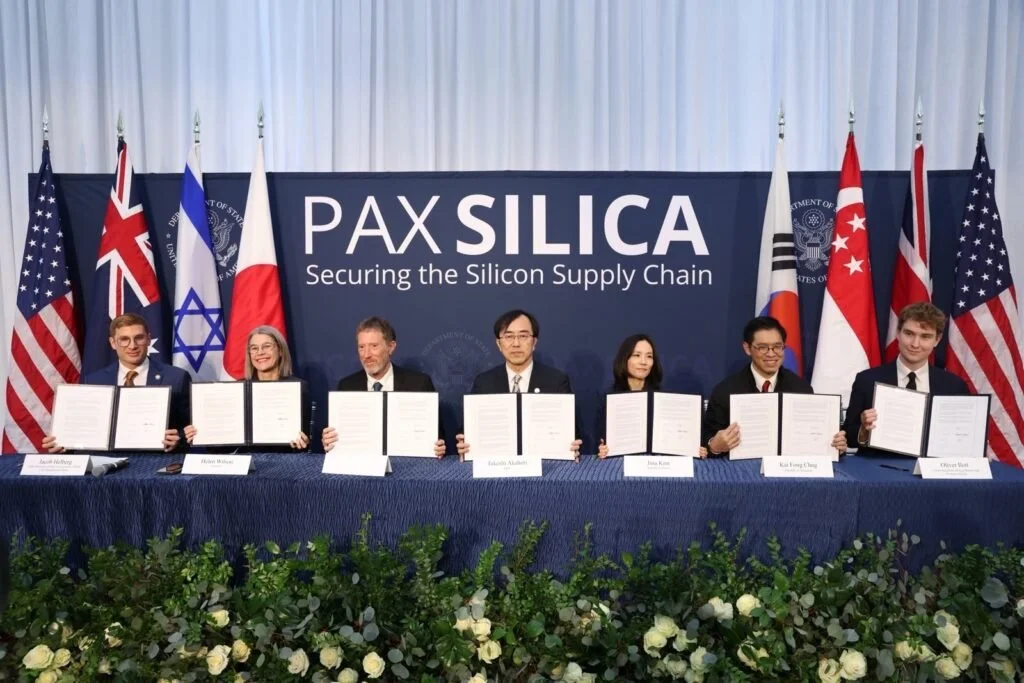
The protests against Pax Silica have been extremely loud and clear nationwide, especially in Luzon, coming from various political camps.
No to Pax Silica
The reality, however, is far more complex.
Pax Silica is arguably something that should have been pursued ten years ago. Yet we, the Americans, Taiwanese, and others were all equally naive, avoidant, or outright selfish in failing to recognize the necessity of a program to secure our respective positions in an increasingly competitive technological and geopolitical landscape. We got so caught up in the culture wars of the 2010s that we didn’t see the Chinese Civilization-State wake up ready to take its place to replace the current “Pax Americana” with its own “Pax Sinica” for its own benefit.
Our peace has, in many ways, been maintained by a United States that repeatedly enters conflicts to preserve not only its international standing but also the very economic and political structures that sustain its global influence. We live within this peace maintained by the United States, whether we like it or not. It is an arrangement that has, to some extent, kept us away from the far more violent realities of neo-colonial exploitation happening elsewhere in the world, where the pursuit of profit, resources, and technological advancement continues to come at the expense of local populations. We need only look at the various extractive and industrial practices being undertaken by major powers, including China and other rapidly industrializing economies, particularly in parts of Africa and Indonesia, to understand that economic development does not necessarily translate into the betterment of the people who make it possible.
AI also plays a role in all of this. However, I think we need to look beyond the immediate obsession with artificial intelligence and recognize the technological limitations we are currently facing. The industry has placed enormous bets on GPU-based computing, attempting to scale computational capabilities by adopting increasingly expensive, energy-intensive hardware and infrastructure. There is growing concern about whether this trajectory is sustainable, particularly as other forms of computing, including quantum computing, continue to develop. The reality is that AI, as it stands, is another progression of our longstanding human obsession with making things increasingly efficient, convenient, and seemingly flawless. It is not an isolated technological revolution but part of a much larger competition over who gets to develop, control, and benefit from the technologies that will define the future.
Now here we are today, a nation divided over it. The reality is that there are Filipinos who recognize the potential economic and industrial opportunities that an initiative like Pax Silica could bring, particularly in terms of manufacturing, technological development, and employment. Yet many of these considerations are being drowned out by the equally legitimate concerns surrounding sovereignty, foreign intervention, displacement, and the possibility of becoming further entangled in another country's geopolitical interests. Meanwhile, opposition to the initiative is being articulated by different political camps, from the progressive left to the Duterte camp's more ostensibly neutral position of keeping the Philippines out of great-power competition altogether. A naive dream made by those who haven’t seen the centers of power firsthand and interacted with them.
In a way, this is also an argument between the various departments of our own government, particularly the DFA, DND, and DTI, and the different visions they represent for the country's future. It is an argument about our manufacturing capabilities, our industrial policy, and how we should approach industrialization in the first place. Should we aim high and attempt to establish ourselves in advanced manufacturing, semiconductor production, and other strategic industries, even if doing so means entering an increasingly competitive geopolitical arrangement? Or should we remain cautious, prioritize our existing economic relationships, and risk being left behind as other countries consolidate their positions in these industries?
This is our Vietnam moment in several ways. In industry, the question is whether we are to become a powerful economy at the cost of our own people and environment, all for the gains of capital, prestige, security, and so-called prosperity. But prosperity for whom? For us to become our own slaves? Geopolitically, it is the encroachment of the old world's empire into the borderlands of a civilization-state thousands of years in the making. All the while, our masses struggle to collectivize and organize resistance, despite having no true alternative to Pax Silica.
Neither position is without its consequences. Aligning ourselves with Pax Silica does not automatically guarantee industrial development, employment, or economic prosperity. There is no assurance that the Philippines will receive an equitable share of the benefits, nor that our participation will not come with political and economic compromises. We have already experienced what happens when development is pursued without sufficient consideration for the people who bear its costs. The displacement of communities, ecological destruction, the exploitation of labor, and the continued dependence on foreign capital are realities that cannot simply be dismissed in the name of progress.
However, refusing to participate is not without consequences either. We cannot continuously expect to benefit from the technological advancements and industrial developments of other nations while remaining unwilling to develop the domestic capabilities necessary to sustain ourselves. Strategic neutrality, if it is not accompanied by an equally strategic planning and development, risks becoming another form of dependence. We cannot afford to mistake the absence of immediate conflict for the presence of long-term security.
Ultimately, the question should not simply be whether we support or oppose Pax Silica. It should be whether we have the institutional capacity, political will, and strategic foresight to negotiate our participation in such an initiative on terms that genuinely benefit the Filipino people. We should not be so naive as to believe that the United States, China, or any other major power will necessarily act in our interests. Their interests will always come first, and ours must be defended accordingly.
Whether we stick with Pax Silica and its plans or not will depend on how strategically minded the Filipino nation is and how willing we are to confront the realities of the future rather than remain hopeful that we shall somehow be spared its onslaughts. The world is changing regardless of whether we choose to participate in that change. The question is whether we intend to have a hand in shaping our own future, or whether we are content to let others decide what place the Philippines will occupy in it.