
The Death of Institutional Identity
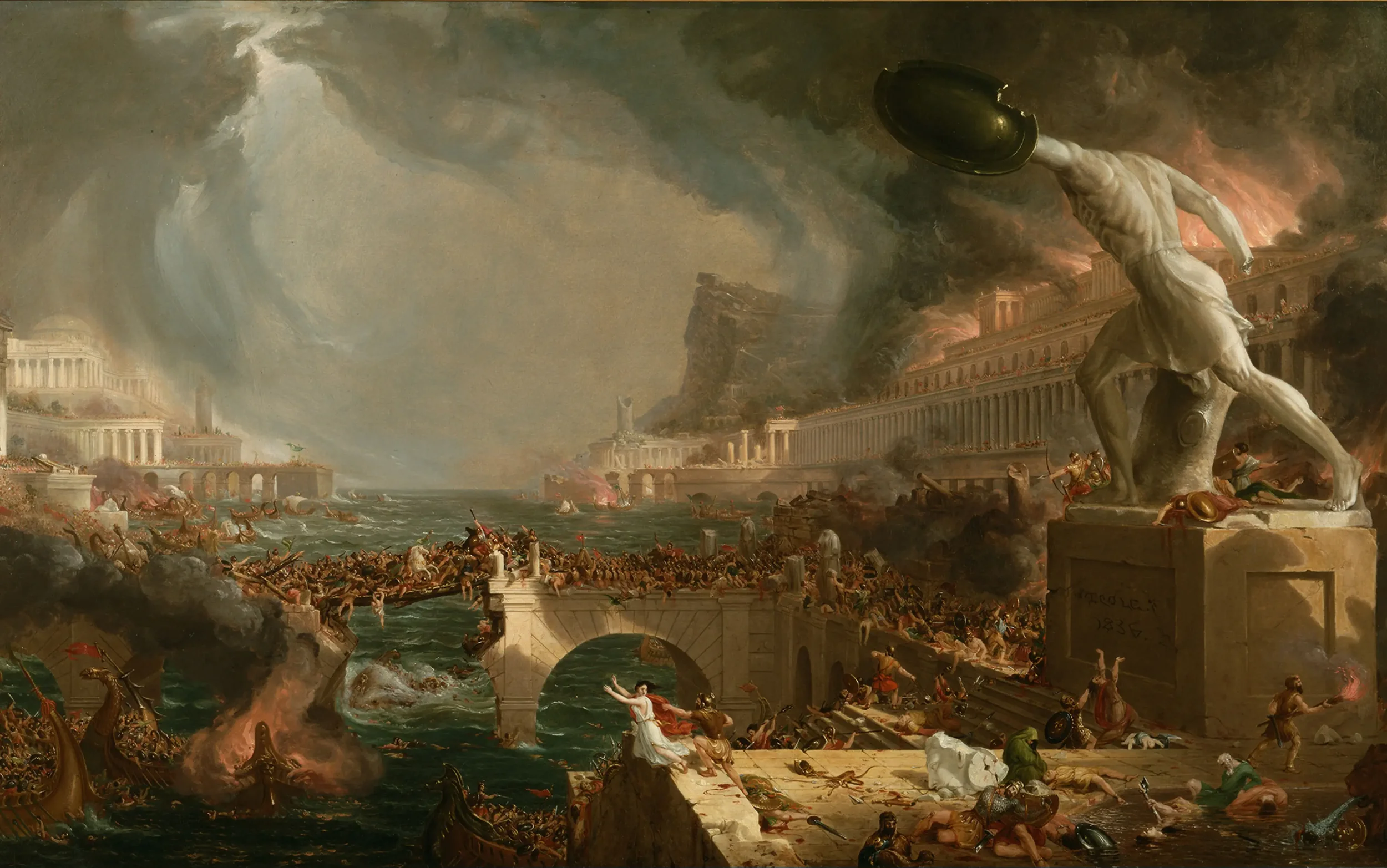
Many institutions start out with a strong mission and vision. But as these institutions begin to expand and take their place in society’s organizational pantheon, one can notice that its institutional vision—or the application thereof—is not quite the same as it was when it first began. A certain nostalgic reaction begins to form among those who retain some memory of the ‘old ways,’ who then seek to correct management priorities by taking over the system.
We can see this in the example of worldwide conservative movements who still put their faith in the democratic electoral process. Talk of 1776 remains a standard for American conservatives who continue to rally around President Trump; while other movements in Europe welcome the advent of strong leaders who they believe can force a reset of government in favor of authentic national values. This line of thought seems entirely sensible—but is at its core erroneous.
What actually happens is that the ‘leader,’ despite some posturing here and there, is completely at the mercy of the system of which he is a convenient figurehead and scapegoat. He is a rubber stamp for the bureaucracy which can and will continue to exist, with or without him. This bureaucracy, in turn, acts in accordance with a certain institutional logic which ensures its stability and continued persistence.
The same can be said for businesses, schools, and other earthly organizational forms dependent on capital. For an organization to maintain its existence those responsible for its operations must act in accordance with its means of sustaining itself. A centralized government needs a certain degree of homogeneity in its population which can be easily taxed. A bespoke tailor needs a small set of trusting clients and a supplier of high-quality cloth.
For this reason, it is completely possible to dislike or even recognize the adverse effects of a particular management decision or style while at the same time acknowledging its necessity given the concrete situation at hand and the demands of the institution at hand. This is especially true for managerial corporations, whose nature it is to expand and bring in more customers and ensure organizational growth; as well as other highly bureaucratized mass-organizations such as those involved in formal education.
Mass organizations entail a different set of priorities than small firms and other ‘mom-and-pop’ kinds of institutions, namely, the prioritization of the social and quantitative over the interpersonal and qualitative. So it should not be surprising that the priorities of a small firm or a small formation center would change when it evolves into a mass corporation or a university. This obviously entails the mutation of the institutional vision into something almost unrecognizable from its more primitive form.
Here I am speaking only of earthly institutions and not the Church, for the Holy Spirit continues to ensure the Church’s perpetual adherence to its Divine Founder’s original intentions, bureaucracy notwithstanding. In fact, it is a sign of God’s special providence over His Church that He in various times and places animates particular souls with special charisms in order to bring forth new and vigorous ways of living in the Church; even despite man’s tendency towards bureaucracy, homogenization and complexity.
At the same time it should be acknowledged that the loss of institutional identity for human societies upon massification is a feature, not a bug of mass organizations. Organizational culture does not exist in a vacuum; but rather goes hand in hand with organizational structure. It is in the nature of mass organizations to disregard the family and local community, to encourage alchemic homogenization, and to leave at its wake identities originating from that globalist process which “makes us neighbours, but does not make us brothers” (Francis, Fratelli Tutti, n. 12).
New identity groups based on one’s class, preferred political candidate, sexual orientation, mental illness, musical tastes, celebrity crushes, Kpop fanbase and the like; all of which are augmented, if not created, by the same agents of homogenization (the corporations, mass media and bureaucracy), have now replaced the communities most fundamental to man: family and locality. The atomization of persons into modern ‘individuals’ has given rise to the most stifling collectivisms: mixtures of nationalism and socialism have become dominant today (John Lukacs, Outgrowing Democracy, p. 159).
Hence it is folly to think that one can return to the ‘old ways’ by making use of the machinery that exists on the basis of replacing the local (of which most traditions consist of) with the large-scale. Ernest Gellner’s Nations and Nationalism pointed out how the nationalist movements of the past two centuries consisted primarily in the replacement of local cultures with an artificial ‘high culture,’ which in turn claims to be a continuation of the local tradition, for “it was the great ladies at the Budapest Opera who really went to town in peasant dresses, or dresses claimed to be such” (p. 57).
An effective tradition-oriented movement, therefore, must think in structural terms. If one seeks to preserve and restore tradition; one must return to a keen sense of the small-scale, the local, and the interpersonal. Otherwise we are left with an illusion: the machine which uproots and destroys traditions thus presents itself as the agent of reaction and return—when in reality it simply places a traditionalist veneer over the corrosive fog of so-called modernity.
