
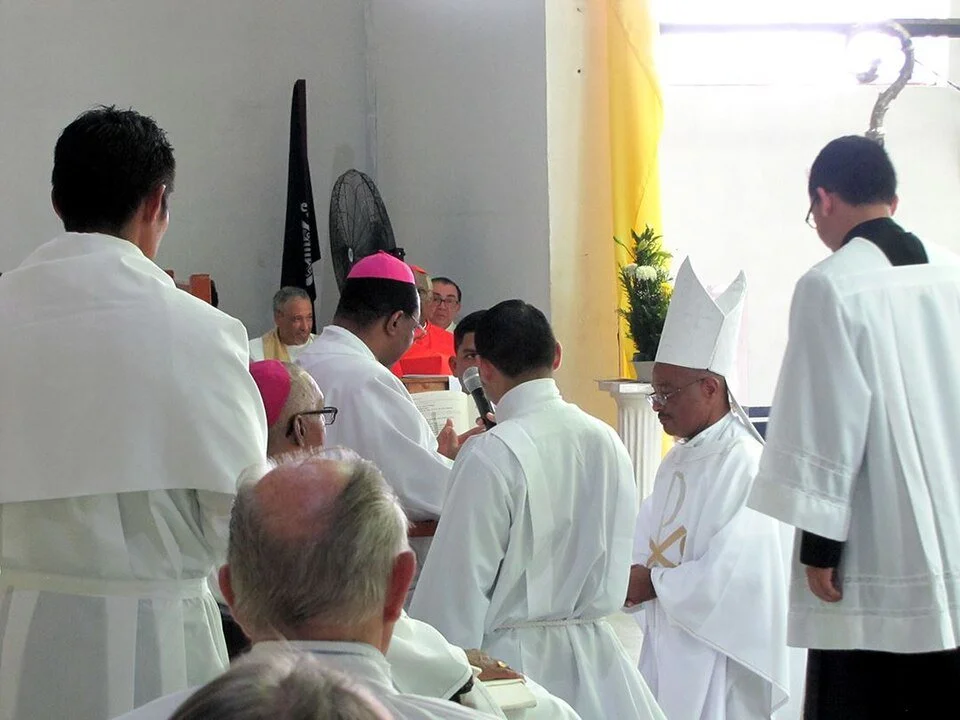
Some traditional Catholics and sedevacantists entertain grave doubts about the validity of the priests and bishops ordained according to the new rituals promulgated by St. Paul VI in 1968. To substantiate their doubts, they cite Ven. Pius XII’s apostolic constitution Sacramentum ordinis, which states that the form of the sacrament of orders univocally (“univoce”) mentions both the power of order (potestas ordinis) and the grace of the Holy Spirit.
The text of Sacramentum ordinis declares: “Wherefore, after invoking the divine light, We of Our Apostolic Authority and from certain knowledge declare, and as far as may be necessary decree and provide . . . that the form, and the only form, is the words which determine the application of this matter, which univocally signify the sacramental effects – namely the power of Order and the grace of the Holy Spirit – and which are accepted and used by the Church in that sense.” They then argue that the essential words of the consecration of a bishop do not mention the power of order in a sufficient way, hence invalidating the rite.
Let us compare the old and the new rites side-by-side. The essential words of the old rite read: “Perfect in Thy priest the fullness of thy ministry [ministerii tui summam] and, clothing him in all the ornaments of spiritual glorification, sanctify him with the Heavenly anointing [caelestis unguenti rore sanctifica].” In this formula, the ‘fullness of thy ministry’ signifies the power of order (the high priesthood), while the ‘Heavenly anointing’ signifies the grace of the Holy Spirit.
Whereas the essential words of the new rite read: “Now pour forth upon this chosen one the power that is from you, the governing Spirit [spiritum principalem], whom you gave to your beloved Son, Jesus Christ, and whom he gave to the holy Apostles, who established the Church in each place as your sanctuary to the glory and unfailing praise of your name.” Sedevacantists claim that the phrase ‘governing spirit’ fails to signify the power of order and therefore does not suffice for validity.
Most arguments with respect to the validity of the 1968 episcopal consecrations hinge on the meaning of the ‘spiritus principalis’ or ‘governing spirit.’ However, this controversy in many ways stems from a misunderstanding of what Sacramentum ordinis means by ‘form,’ which many assume only means the essential words. This, however, is not the sense in which Sacramentum ordinis speaks of the sacramental form.
On the contrary, Pius XII in Sacramentum ordinis refers to the entire consecratory preface as the form of the sacrament of Holy Orders: “The form consists of the words of the ‘Preface . . . .” Of this form, there are certain words which are essential, i.e., which cannot be omitted lest the sacrament be invalidated: “. . . of which [Preface] the following [words] are essential and therefore required for validity,” referring to the part that begins with “Perfect in Thy priest.” Hence, when Ven. Pius XII speaks of the ‘form,’ he means the entire preface which goes beyond the essential words. The entire form, in turn, is that which contains both the grace of the Holy Spirit and the power of order univocally.
That the sacramentary preface constitutes the entirety of the sacramental form has been discussed by Dom Bernard Botte O.S.B. in his article “L’ordination de l’Eveque,” as well as Cardinal Giacomo Lercaro who mentions this in a report to St. Paul VI, as reported by Archbishop Annibale Bugnini C.M. in The Reform of the Liturgy, p. 709. Dom Botte, as we know, was the scholar who edited the formula of Saint Hippolytus, which would eventually become the consecratory formula used in the new rite of episcopal consecration.
From this it is clear that the 1968 ‘Novus Ordo’ rite of episcopal consecrations are valid insofar as they mention the power of order through the ‘summum sacerdotium’ or high priesthood (mentioned twice) which Leo XIII’s Apostolicae curae mentions is essential to the Church’s understanding of the episcopate. In English this is usually translated as the ‘high priesthood’:
“Father, you know all hearts. You have chosen your servant for the office of bishop [ad episcopatum]. May he be shepherd to your holy flock, and a high priest blameless in your sight [et summum sacerdotium tibi exhibeat sine reprehensione], ministering to you night and day; may he always gain the blessing of your favour and offer the gifts of your holy Church. Through the Spirit who gives the grace of high priesthood [virtute Spiritus summi sacerdotii] grant him power to forgive sins as you have commanded, to assign ministries as you have decreed, and to loose every bond by the authority which you gave to your apostles.”
Even if we were to interpret the parameters of Sacramentum ordinis contrary to the intention of Ven. Pius XII, i.e., restricting sacramental form to the essential words alone, it is clear from the context of the rite itself that “Spiritus principalis” is nothing other than the “Spiritus summi sacerdotii.” Dom Botte, in “Spiritus principalis (formule de l’ordination episcopale),” notes that the phrase ‘spiritus principalis’ corresponds to nothing else than the “specific functions of a bishop,” among which includes being the “high priest of the new sanctuary.” Canon Andre Rose, in “La priere de consecration pour l’ordination Épiscopal,” also corroborates the exercise of the high priesthood as belonging to the functions conferred by the ‘spiritus principalis.’
Of course, one should admit that there is an overwhelming emphasis on governance (as Susan Wood notes), which is to be understood, according to the explanatory note in Lumen gentium, not in terms of canonical mission (the “juridico-canonical aspect”) but in terms of the ontological character of the episcopate expressed in terms of ‘functions’ (munera).
It is ridiculous to say that the rite seeks to diminish the understanding of the bishop as ‘high priest.’ It is true that the reformers found the traditional sacramental form ‘scanty’ and not as doctrinally rich as the one contained in the Hippolytan formula, based on the fact that it only speaks of the high priesthood and not things such as the episcopal office or apostolic succession (Bugnini, The Reform of the Liturgy, 714). But this does not entail a rejection of the Catholic understanding of the bishop as high priest; in fact, it entails a reassertion of the Catholic understanding of the bishop as high priest.
The complaint brought forth by many liturgical reformers was not that the episcopate was expressed in terms of the high priesthood, but that the apostolic nature of the high priesthood risked being obscured through the preponderance of Old Testament imagery which present the bishop as the successor of the Aaronic high priests (ibid). While the latter fact is true, the high priesthood of the bishops according to the order of Melchizedek is substantially different from the hereditary Aaronic priesthood.
In fact, if the manifest intention of the reformers count for anything, the use of the word ‘high priest’ in the ICEL cannot be interpreted as anything other than the apostolic high priesthood, the power of order proper to a Catholic bishop (and not an Aaronic high priest). And, while perhaps the reformers may have wanted to emphasize other aspects of the episcopate other than the high priesthood (such as the episcopal office and apostolic succession — both things essential to the Catholic understanding of the episcopate), it would be unjust to impute to the reformers an intention to minimize the high priesthood in a way that would vitiate sacramental intentionality.
Of course, even if the reformers were ill-intentioned in their task of revising the sacramental rites, the ultimate and overriding intention by which the texts should be interpreted should not be that of the scholars involved in their production, but that of the Supreme Pontiff who promulgates and approves these texts in the name of the Church. And it is clear, from a reading of Lumen gentium, that the traditional teaching on the nature of the episcopate persists.
For this reason, it is clear that the 1968 rite of episcopal ordination fulfils all the conditions set forth by Sacramentum ordinis. To assert otherwise would bring one against a plain reading of the parameters of Sacramentum ordinis and the prayer of episcopal consecration itself.
