
A Bright New Voice at the Opera: Michelle Mariposa at “Opera at Kundiman”
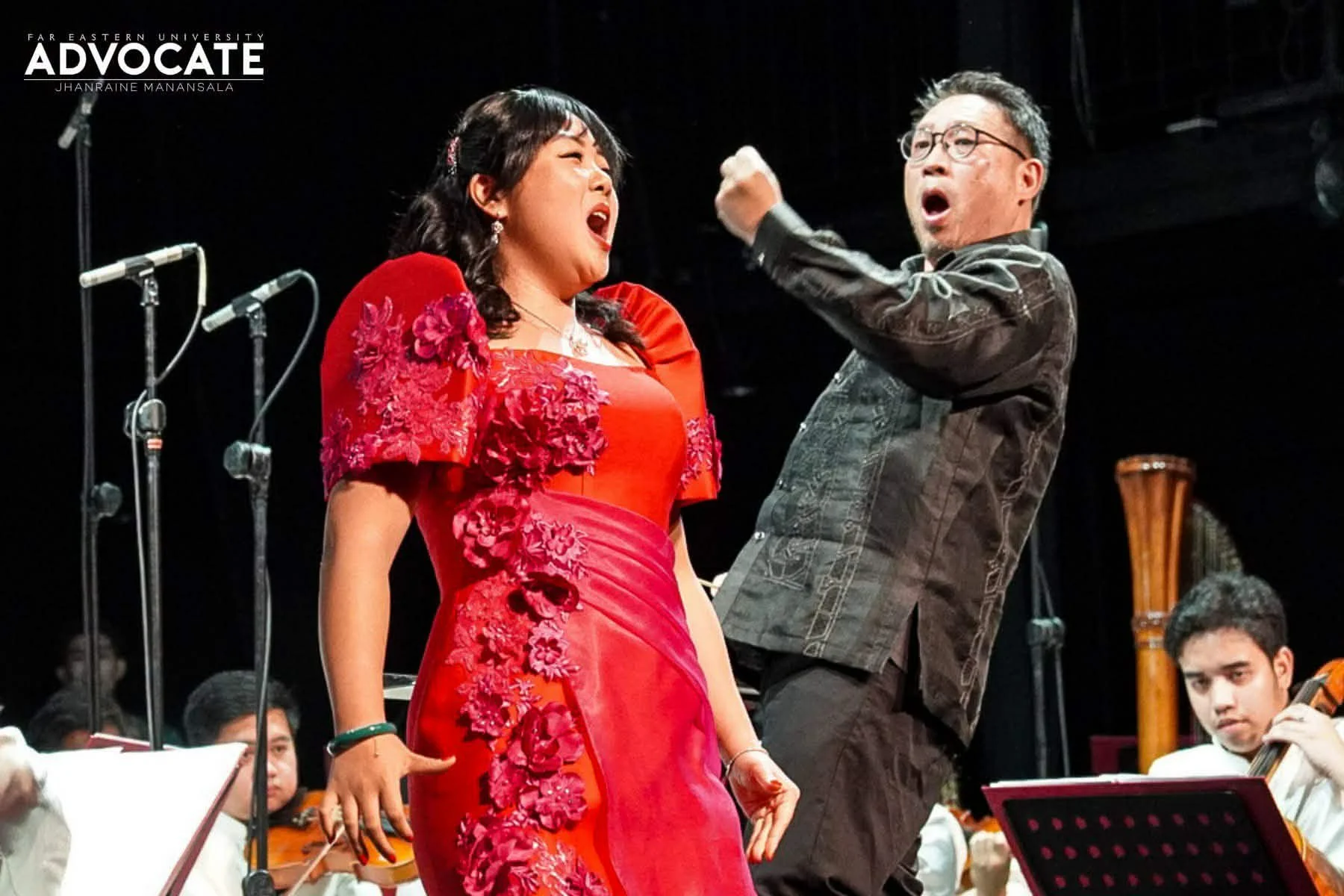
Image source: Jhanraine Manansala with FEU Advocate
The topic of opera rarely comes up within the Philippine zeitgeist, much less in discussions on Filipino singing.
We often hear the voices of Lea Salonga, Regina Velasquez, or Gary Valenciano. Incredible singers in their own right, they have cemented the connotation of Filipinos dominating the rock-ballad genres of singing. Yet, within the realm of operatic singing, the Filipino voice is hardly ever heard.
The likes of sopranos such as Jovita Fuentes, Conching Rosal, Dalisay Aldaba, and the legendary baritone Jose Mossesgeld Santiago have rarely come about in recent times. Their voices were crafted during the last few decades of the old-school bel canto tradition of operatic singing, in line with the Italian tenors who kept the tradition before the advent of the Verismo tradition of singing brought about by tenor Enrico Caruso and baritone Tita Ruffo. Post World War II, singers began to put more weight on the voice and brought about the "Golden Age" of the 1950s-1970s with Maria Callas, Leontyne Price, Giuseppe Di Stefano, Ettore Bastianini, Franco Corelli, and Mario Del Monaco.
There is certainly some pride to be taken in the fact that a few Filipino singers were able to take part in the old tradition which started in Italian operas. But the decades following that time saw less and less of true bel canto singing.
Nowadays, singers from all over the globe sing in a style vastly different from the old tradition, which can be appealing for some and disagreeable to others. I am in the camp of the latter, which is why mezzo-soprano Michelle Mariposa proved to be such a breath of fresh air. Her career started at the University of the Philippines College of Music; thus, her voice is a local product, further honed after taking a Master’s degree in Voice and Opera Performance at Northwestern University.
When I decided to watch “Opera at Kundiman”—a concert comprising a selection of arias and sections from the opera “Carmen” by but sung in Tagalog, as well as kundiman art songs from the likes of Nicanor Abelardo and Francisco Santiago, performed by the Manila Symphony Orchestra and the FEU Chorale at the Far Eastern University auditorium—I felt that something special was in store.
Soprano Rachelle Gerodias, Tenor Arthur Espiritu, and Baritone Byeong-In Park have already had careers spanning several years and well-established reputations within the Philippine opera space—Gerodias was even hailed as one of the best in the country during her time—and so it was a stacked line-up. But the highlight of the night was mezzo-soprano Michelle Mariposa, who is still making her way in the world of Philippine opera. Despite her youth she greatly astounded me, and so I will spend the rest of this article sharing my thoughts on her performance.
Mariposa’s voice is an absolute accomplishment in terms of vocal training. Her technique displays mastery of the fundamentals and is sonically pure, and because of that, its execution was very complete. Her “appoggio” or diaphragmatic support was clearly maintained during every second of every note during the entire performance. There is no hint of unhealthy “pushing” for the sake of volume.
Her voice had a sufficient squillo—a hallmark of the bel canto singing tradition—which enabled it to pierce cleanly through the orchestra up until the very back of the auditorium. Furthermore, her ability to perform a “messa di voce,” or a gradual diminuendo, was a remarkable feat in and of itself. Dynamics is hard to come by, perhaps more so than singing with a sufficiently loud voice. Her voice was round and robust, but not bloated or overly manufactured. Her production was not overtly dark, and there was a presence of genuine “chiaroscuro” within it. Frankly, every element of what makes a good voice was present within hers. Lastly, her voice showed no sign of a “wobble” within her vibrato, a sure sign of proper technique.
This is a complete return to form, which highlights a healthy and productive voice. What convinced me of this was her ability to sing through a handful of arias and kundimans and still keep up with her more experienced peers during the quartet finale of the entire concert. In fact, upon finishing “L'amour est un oiseau rebelle,” her voice began to show further color and expressiveness, as if the aria was simply her warm-up. The kundimans thereafter showed us a glimpse of her current vocal peak, and it was exceptional.
I sincerely hope that Miss Mariposa develops her instrument further and does not pick up any destructive vocal habits, such as taking heavy dramatic repertoire too early. There is a reason why singers avoid the more dramatic roles of Verdi or Puccini until they reach their forties. There is no point in tackling material one’s vocal cords are not yet ready to handle. With that being said, I pray that her voice withstands the test of time so that it may present itself to many more theatres at home and abroad.
Overall, the concert was a very pleasant experience. Gerodias and Espiritu showed cleverness in their diction, Park showed the right amount of flamboyance in his execution, and Mariposa greatly embodied and expressed sheer sultry power in her performance as Carmen. The Manila Orchestra had a particularly on-point tempo, and the FEU Chorale was the cherry on top.
Opera is a naturally inaccessible art form in this country. Hence, efforts to preserve this tradition, which began a little over a century ago, tend to come and go. Nevertheless, endeavors such as this, along with the presence of singers such as Michelle Mariposa, allow us to hope for the continued future of Filipino opera and the bel canto tradition.
Sean Cruz is the Internal Vice President of the Collegium Perulae Orientis. He is currently taking a Bachelor’s Degree in Economics but has interests in Opera and Film.