
We Need More Fulton Sheens
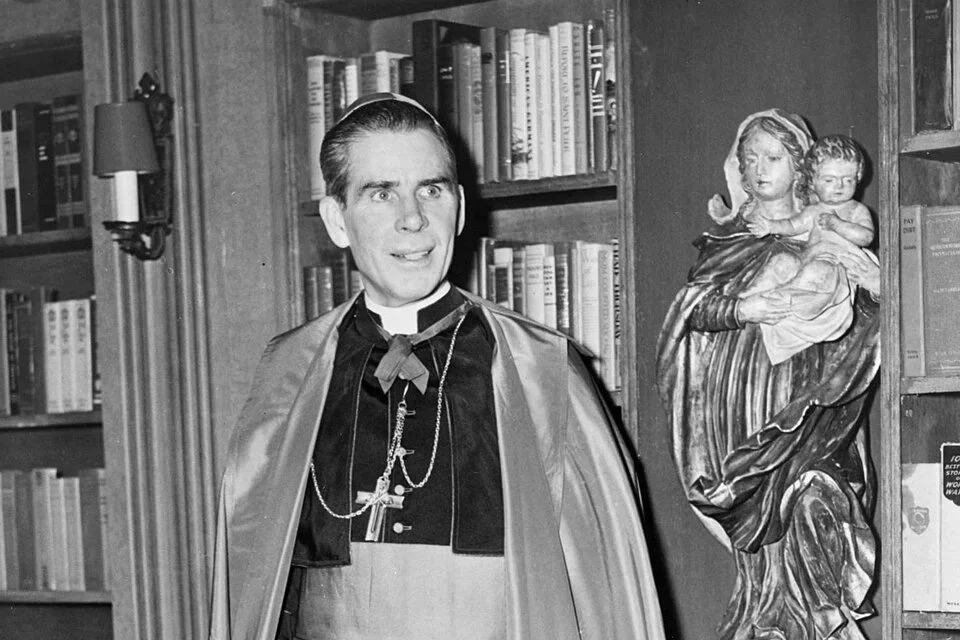
“You are the worst speaker in the world.”
Those were the words spoken by Fulton Sheen’s debate instructor when he was still a college student. Little did that instructor—or perhaps even Sheen himself—know that the young man before him would one day become what the Catholic University of America called “The Great Communicator.”
Now that Blessed Fulton J. Sheen got beatified today, I find myself asking a simple question: What made Sheen so effective, and why do we need more people like him today?
After all, when you look at Life Is Worth Living, it is almost comically simple. An old bishop stands before a chalkboard, writes a few words, and talks to a camera. There are no elaborate sets, no flashy graphics, and certainly no modern production tricks. Yet millions tuned in every week.
So what was the secret?
Sheen understood that communicating Catholicism did not mean making it complicated. He did not throw ancient theological texts at his audience and expect them to immediately understand. He spoke plainly—sometimes even casually—and he could take a difficult philosophical or theological question and connect it to something his viewers had encountered that very week in a newspaper or magazine.
That was the genius of Sheen: he made the timeless intelligible through the ordinary.
And his audience was not composed entirely of theologians and seminarians. The people watching him were ordinary Americans: mothers folding laundry, fathers coming home from work, young people sitting in their living rooms, and people who may have known very little about Catholic theology. Yet Sheen could speak to them without speaking down to them.
That is something I think Catholic communicators today can learn from.
Sheen also never needed to pretend to be something he wasn’t. He did not imitate a Protestant street preacher to make Catholicism seem more acceptable, nor did he dilute his Catholic identity to appeal to a wider audience. He was unmistakably Catholic. He spoke about Christ, the Church, sin, grace, morality, the saints, and the Sacraments with the confidence of a bishop—but he explained them in a language ordinary people could understand.
That balance is difficult. He was accessible without becoming shallow and orthodox without becoming pedantic.
And this mattered especially in Sheen’s America. Catholicism was not always treated as an ordinary part of American life. Anti-Catholic prejudice was widespread, and the growing presence of Catholic immigrants sometimes made the Church a target of suspicion and hostility.
Sheen did not answer that hostility by hiding his Catholicism. Instead, he used his own voice and experience to show people the beauty of the faith he had received.
He did not merely tell people that Catholicism was true. He showed them why it was worth listening to. But perhaps the most important part of Sheen’s legacy has little to do with television at all.
It was the man behind the camera.
Sheen’s effectiveness did not come simply from his ability to read a script or deliver a memorable lecture. There was a sense that the man standing before the chalkboard was the same man who celebrated Holy Mass, prayed before the Blessed Sacrament, met ordinary people, and lived his vocation when nobody was watching.
Cardinal Francis Spellman was particularly suspicious, or so he said, about Sheen behind the curtains after they had disputes on Church funds. Spellman looked and looked for any dirt on the Bishop. Yet his efforts were for naught. He didn't find a single event that would make the public and Rome oust Sheen from his standing in society.
That is Archbishop Fulton Sheen. That authenticity gave his words weight. He truly did believe his motto—life was worth living especially if you always try to be disciplined.
He did not simply talk at people. He talked to them.
And perhaps that is what many Catholic communicators—including myself—can sometimes forget. It is easy to become so focused on winning an argument, defending a position, or producing the perfect Catholic response that we forget the person on the other side of the screen. Recently that hits very close to home.
Sheen understood that communication is ultimately about people.
The Great Communicator was not called great merely because he could speak beautifully. He was great because his communication pointed beyond himself. His goal was not simply to make people admire this person named Fulton Sheen. It was to make people think about our Lord and Savior Jesus Christ.
That distinction matters.
I know I have made mistakes in my own efforts to speak about my faith and my convictions. I know what it feels like to be misunderstood, and I know how easy it is to become frustrated when something you intended for good is received very differently from how you imagined it.
That is why I often ask Bishop Sheen to pray for me.
I don’t ask the Lord to make me famous. I don’t ask Him to make every argument I make successful. I ask Him to help me become the kind of communicator who remembers why he is speaking in the first place.
Because Catholic communication should not ultimately be about ourselves.
It should be about Christ.
Perhaps that is why Sheen’s legacy still matters in an age of microphones, podcasts, livestreams, TikToks, columns, and comment sections. We have more ways to speak than Sheen ever could have imagined, but having a larger platform does not automatically make us better communicators.
We need more Catholics who can explain the faith without watering it down. More Catholics who can speak boldly without becoming needlessly hostile. More Catholics who can defend truth while remembering that the person listening is made in the image and likeness of God.
In other words, we need more Fulton Sheens.
Sheen was given the gift of communication. He turned a chalkboard into a pulpit, a television program into a catechetical lesson, and millions of living rooms into places where people could encounter the Catholic faith.
Now, as the Church honors him as Blessed, his example leaves us with a challenge.
If God has given us a voice, what are we going to do with it?
May Bl. Fulton J. Sheen pray that we use ours wisely. May we speak clearly. May we speak charitably. May we speak courageously.
At his prime he spoke to 30 million people weekly. Now, he inspires a Church that has billions.
So above all, may we never forget that the greatest communicator is not the one who makes people remember his name, but the one who uses his voice to help people remember His.
Contra Mundum; Pro Veritate